At first glance, the puzzle looks incredibly simple.
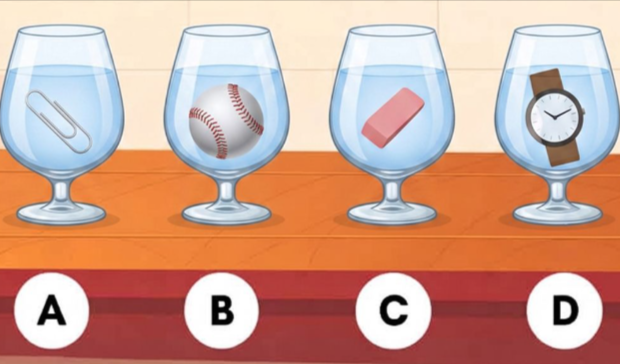
Four glasses labeled A, B, C, and D appear to contain nearly identical amounts of water. But inside each glass sits a different object — and that tiny detail changes everything.
The challenge sounds easy:
Which glass actually contains the most water?
But as thousands of people discovered online, the answer depends on whether you focus on appearance… or physics.
Glass A contains a paperclip.
Glass B holds a baseball.
Glass C contains an eraser.
Glass D has a wristwatch.
Most people immediately judge the puzzle based on water level alone. Since all four glasses appear equally full, the brain instinctively assumes the amount of water must be roughly the same.
That’s where the trick comes in.
The key to solving the puzzle is understanding displacement.
Every object placed inside the glass takes up space. The larger the object, the less room remains available for actual water.
That means the correct answer is Glass A.
Because the paperclip is the smallest object, it displaces the least amount of water. In other words, Glass A contains more real water than the others, even though the surface levels appear similar.
Meanwhile, the baseball in Glass B takes up a huge amount of space, meaning there’s actually far less water inside despite what your eyes initially suggest.
It’s a simple scientific principle — but one that easily tricks the brain.
And that’s exactly why puzzles like this spread so quickly online.
People love discovering whether they rely more on instinct, logic, or visual assumptions when making decisions.
Over time, the puzzle even evolved into a playful personality test, with different interpretations based on which glass people choose first.
If you picked Glass A, you’re often described as analytical and detail-oriented. You probably slow down before making decisions and prefer facts over appearances. People who choose A tend to notice hidden details others miss.
If you chose Glass B, it may suggest you trust first impressions and visual information strongly. You likely make quick decisions confidently and rely heavily on intuition.
People who select Glass C are often described as balanced thinkers — individuals who combine creativity with logic and consider several possibilities before settling on an answer.
And those drawn to Glass D are sometimes viewed as abstract or emotionally intuitive thinkers who focus more on symbolism, meaning, or deeper interpretation than pure logic.
Of course, none of these personality descriptions are scientific facts. They’re simply part of the fun.
The real reason these puzzles become so addictive is because they reveal something surprisingly important about human perception:
What we see is not always reality.
Our brains constantly simplify information, relying on assumptions and shortcuts to make quick judgments. But sometimes, the smallest overlooked detail completely changes the truth.
In this case, that detail was as tiny as a paperclip.
It’s also why visual riddles feel strangely satisfying. They challenge us to pause, rethink our assumptions, and look beneath the surface rather than accepting the obvious answer immediately.
And honestly, that lesson applies far beyond puzzles.
In everyday life, the loudest thing in the room is not always the most important. The biggest object does not always contain the most substance. And sometimes, people who quietly observe before reacting end up understanding far more than everyone else.
So now the real question is:
Did you pick Glass A immediately… or did the puzzle fool you the first time?