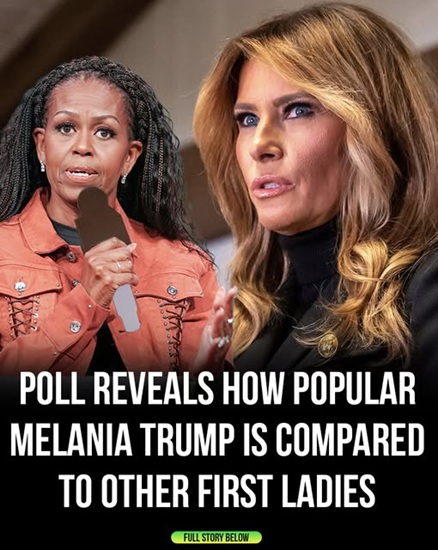
A recent public opinion survey examining how Americans view former and current First Ladies has sparked renewed discussion about political image, public perception, and how historical figures are remembered. The poll surveyed approximately 2,255 U.S. adults and asked respondents to rate several First Ladies on a scale ranging from “outstanding” to “poor.” The results highlight both strong public admiration for certain figures and deep divisions in how more recent First Ladies are viewed.
The findings show that while some First Ladies continue to enjoy highly favorable reputations, others receive more mixed or negative ratings depending on political affiliation and public perception of the presidency they were associated with. The survey reflects broader trends in modern political opinion, where public figures are often evaluated through highly polarized perspectives. This division is especially noticeable when comparing historical First Ladies to more recent ones.
Among the First Ladies included in the survey, Jacqueline Kennedy Onassis stood out as the most positively regarded overall. She received significantly higher favorable ratings compared to others, with many respondents describing her legacy as enduring and historically influential. Her continued popularity reflects a long-standing public fascination with her time in the White House and her cultural impact during and after that period.

Other First Ladies who received relatively strong positive ratings included Rosalynn Carter, Nancy Reagan, Lady Bird Johnson, Barbara Bush, Michelle Obama, and Laura Bush. These figures generally received net positive or moderately favorable evaluations in the survey. Their approval ratings suggest that many Americans view their time in the White House positively, often associated with stability, advocacy work, or public engagement initiatives during their husbands’ presidencies.
Michelle Obama, in particular, remains one of the more consistently well-regarded modern First Ladies in public opinion surveys. Respondents frequently associate her tenure with public health initiatives, education programs, and a strong public presence that extended beyond traditional ceremonial roles. Similarly, Rosalynn Carter and Nancy Reagan continue to be viewed favorably for their advocacy work and public service contributions during and after their time in the White House.
However, the survey also shows that more recent First Ladies tend to receive more divided responses. According to the YouGov findings, Melania Trump received a net negative rating, placing her among the lower-ranked First Ladies in the poll. Hillary Clinton also received a similar negative net rating, with both figures reflecting the broader political polarization surrounding modern American political families.
The data indicates that Melania Trump’s ratings are significantly influenced by partisan differences, with more favorable responses from Republican-leaning participants and less favorable responses from Democratic-leaning participants. This pattern is consistent with how other recent political figures are evaluated in modern polling, where party identification strongly affects public opinion. The survey suggests that First Lady evaluations are increasingly shaped by broader political attitudes rather than personal role alone.
Jill Biden, the current First Lady at the time of the survey, also received a slightly negative net rating, though less extreme compared to some other recent figures. Like others in the study, her results reflect a polarized political environment where public figures are often evaluated within the context of their spouse’s presidency and political legacy.
The poll also highlights how public perception of First Ladies has evolved over time. Earlier First Ladies such as Jacqueline Kennedy, Lady Bird Johnson, and Barbara Bush tend to receive more consistently positive ratings across political groups. In contrast, more recent First Ladies are more likely to experience sharply divided opinions, often reflecting the increased polarization of modern American politics.
This shift suggests that historical distance may play a role in shaping public perception. Figures from earlier decades are often viewed through a cultural or historical lens, while more recent First Ladies are evaluated in real-time political contexts. As a result, their public image tends to fluctuate more depending on current events and political sentiment.
The survey also places First Lady ratings within a broader political context, comparing them indirectly with public views of U.S. presidents. In many cases, First Ladies receive slightly more favorable ratings than their spouses, although there are exceptions. This pattern suggests that First Ladies are sometimes viewed more through cultural or humanitarian contributions rather than strictly political performance.
According to the methodology described in the survey, the sample was carefully balanced across demographic categories such as age, gender, education, geographic region, and political affiliation. The results were also weighted to reflect recent voting patterns and national population data, ensuring a representative overview of public opinion.
Overall, the findings illustrate how the role of the First Lady continues to be both symbolic and politically interpreted in the United States. While some figures maintain strong historical legacies that transcend political divisions, others remain closely tied to contemporary political debates. This creates a dynamic and evolving public perception that changes depending on both historical context and current political climate.
In conclusion, the poll reflects a complex picture of how Americans view First Ladies across different eras. While admiration remains strong for certain historical figures, more recent First Ladies often find themselves evaluated within a highly divided political environment. The results highlight how public opinion is shaped not only by personal legacy, but also by broader national attitudes toward politics, leadership, and history.